What Is Integrated Construction Project Management? Diman’s Approach, From Feasibility to Handover
Building in Iran often looks like an orchestra playing without a conductor. The designer hands over the drawings and leaves, the contractor builds by their own reading of them, the supervisor stops by a few times, and the sales team ends up selling something they had no say in shaping. Everyone did their own job; no one is accountable for the result as a whole.
Diman Group exists to close that gap: a single management track that runs from the first feasibility study on a piece of land to the day the building is handed over and operating.
Where’s the problem? Fragmented work, scattered responsibility
When every phase of a project belongs to a separate party, three things happen almost every time:
- Information gets lost between phases. What the designer had in mind isn’t necessarily what ends up built on site.
- Decisions get made in isolation. Each party optimizes for their own piece, not for the project as a whole.
- The owner becomes an unwilling coordinator. The landowner or investor ends up mediating between several parties without having the expertise to do it.
The result is familiar to anyone who’s built something: rework, delays, and arguments over whose mistake it was.
What does integrated management actually mean?
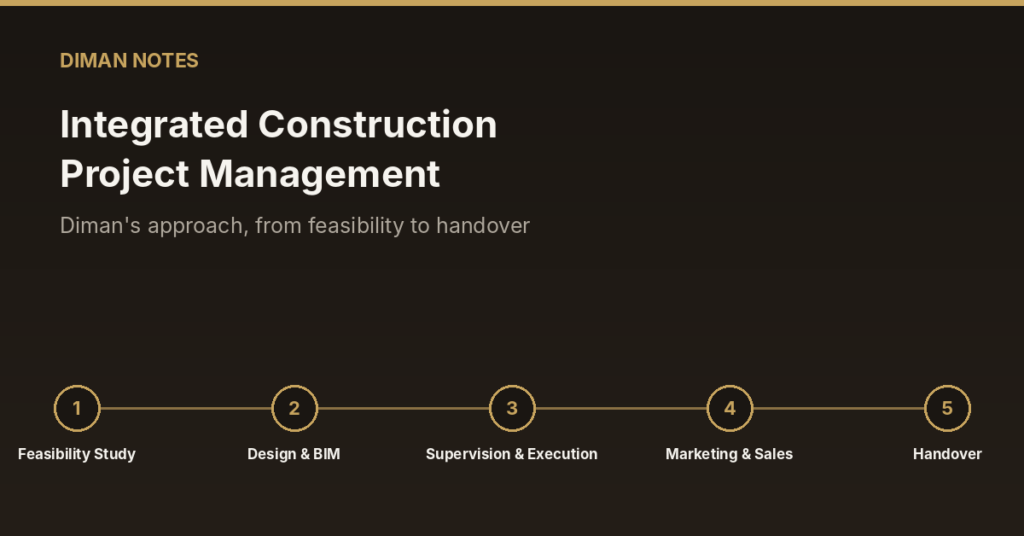
Integrated management means one team leads the entire project cycle and is accountable for the final outcome. At Diman, that cycle has five stages:
- Feasibility Study: before any decision is made, the land, regulations, market, and budget are reviewed to see whether the project is worth building at all.
- Design & Building Information Modeling (BIM): architecture, structure, and systems are designed in one shared model, so conflicts get resolved on screen instead of on site.
- Supervision & Execution: the same team that knows the design leads the build, with progress reported on a regular basis.
- Market Development & Sales: marketing and selling the project is planned from day one, not after construction is finished.
- Handover: delivering units, technical documentation, and post-handover follow-up are part of the job too.
Three commitments that make this possible
Integration isn’t something an org chart does on its own; it takes three commitments:
- One point of accountability for the whole path. The owner has a single contracting party, and every question has one person to answer it.
- Aligned incentives. Diman’s revenue isn’t tied to how much the project costs, so cost optimization is a shared goal for us and the owner.
- Transparent reporting. Costs, schedule, and progress are shared with the owner on a regular basis.
Seven specialized areas, one management
For one team to cover the whole cycle, Diman is organized into seven areas: project management & execution, research & feasibility studies, legal & contracts, market development & brand, finance & economics, human resources, and information technology. All of them operate under a single management, not as separate companies.
Alongside this structure, we have two complementary ventures: Diyar, the investment gateway for Diman’s projects, and Dirak, the group’s technology platform, currently in development.
Who is this approach for?
- A landowner who wants to build on their land but doesn’t have the time or expertise to coordinate several contractors.
- An owner who wants a clear picture of cost and timeline before breaking ground.
- An investor who wants to know exactly which stage their money is funding, and why.
Frequently Asked Questions
Should we work with Diman from the very first stage? The best results come from starting at feasibility, but a project whose design is already done can still join at the execution stage.
Which cities does Diman operate in? Diman was registered in Kerman in Farvardin 1405 (March/April 2026), and its first projects are focused on the city of Kerman.
How can I invest in Diman’s projects? Through the Diyar platform (mydiyar.ir), for projects that are open for investment.
Own land, or have a project in mind? Get in touch through our contact page to set up an initial consultation.